
Engine Basics
2 Cycle vs 2 Stroke: Engines, Oil, and Fuel Explained
Compare 2 cycle vs 2 stroke engines and oils. Learn why the terms are interchangeable and how to choose the correct oil, standard, and fuel ratio.
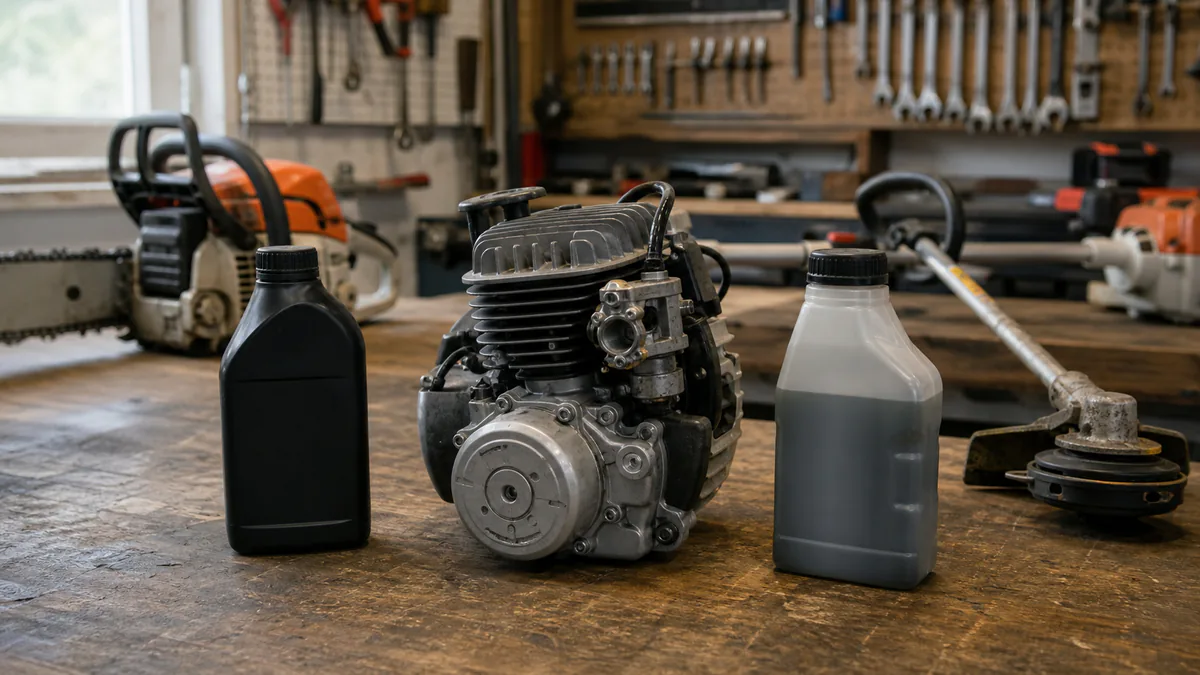
In the 2 cycle vs 2 stroke comparison, there is no difference in engine design. Both names describe an engine that completes one operating cycle in two piston strokes and one crankshaft revolution. “Two-stroke” is simply the more mechanically precise term.
The same naming rule applies to oil: 2-cycle oil and 2-stroke oil belong to the same lubricant category. That does not mean every bottle is suitable for every engine. A chainsaw, dirt bike, oil-injected scooter, and marine outboard may require different formulations, certifications, or delivery methods.
Before buying oil or preparing fuel, identify the equipment model, cooling system, required oil standard, and manufacturer-specified fuel-to-oil ratio. The wording on the front of the bottle tells only part of the story.
Quick Answer
A 2-cycle engine and a 2-stroke engine are the same type of engine. “Stroke” refers to one piston movement, while “cycle” refers to the full sequence of intake, compression, combustion, and exhaust. Likewise, 2-cycle and 2-stroke oils are equivalent names, but their specifications and intended applications can differ.
2 Cycle vs 2 Stroke Terminology
Two-cycle and two-stroke are alternative labels for the same operating principle. One term describes the complete event, while the other describes how the piston completes it.
| Term | What it means | Practical difference |
|---|---|---|
| 2-stroke engine | Completes its operating cycle in two piston strokes | None compared with 2-cycle |
| 2-cycle engine | Alternate name for a two-stroke engine | None compared with 2-stroke |
| 2-stroke oil | Lubricant designed for two-stroke engines | Same general category as 2-cycle oil |
| 2-cycle oil | Alternate label for two-stroke oil | Same general category as 2-stroke oil |
| 2T oil | Abbreviated label often used internationally | Check its specifications and intended use |
| Four-stroke oil | Lubricant for an engine with a separate circulating oil system | Not a substitute for premix oil |
“Two-stroke” is more descriptive because one stroke is a single movement of the piston. The engine uses one upward stroke and one downward stroke to complete a power cycle.
“Two-cycle” became common product and marketing language, particularly on North American outdoor power equipment. It does not mean that the engine has two cylinders, nor does “cycle” refer to a motorcycle.
What Happens During the Two Piston Strokes?
A four-stroke spark-ignition engine separates intake, compression, power, and exhaust across four piston movements and two crankshaft revolutions. A typical crankcase-compression two-stroke combines those processes into two movements and one revolution.
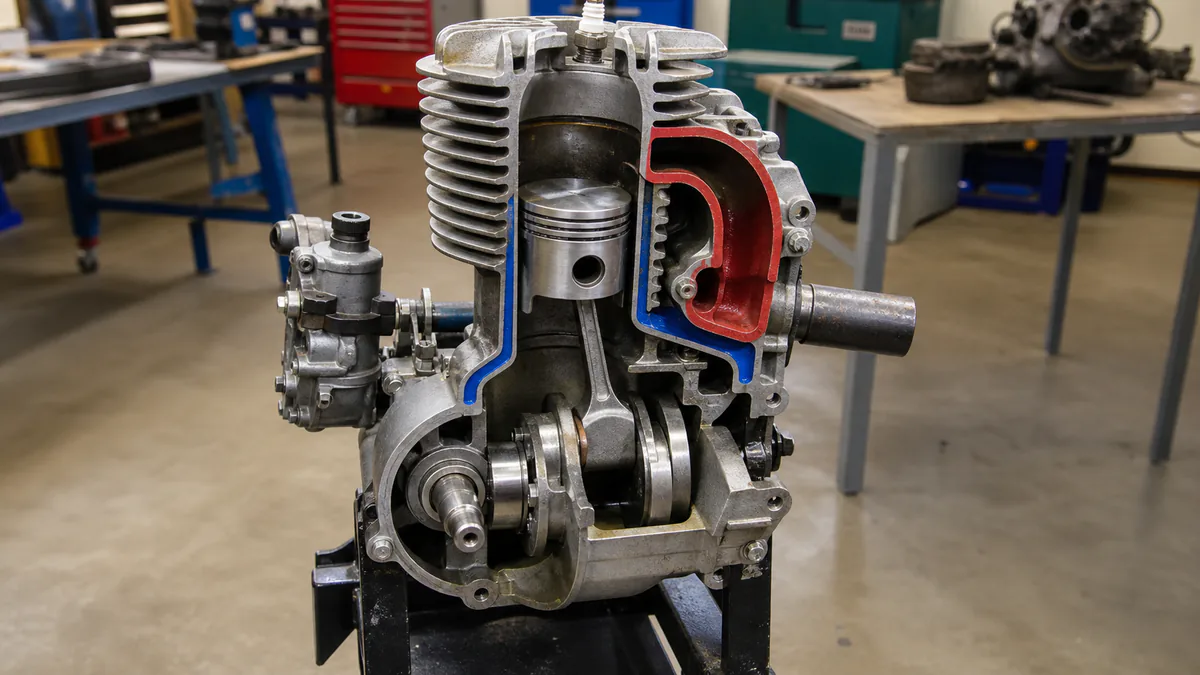
The upward stroke
As the piston travels toward top dead center, it compresses the air-fuel charge already inside the cylinder. At the same time, the movement creates low pressure in the crankcase, allowing a fresh fuel-air charge to enter through the intake system.
Near the top of the stroke, the spark plug ignites the compressed charge.
The downward stroke
Combustion pushes the piston down and turns the crankshaft. As the piston approaches bottom dead center, it uncovers the exhaust and transfer ports. Burned gases begin to leave, and a fresh charge moves from the crankcase into the cylinder.
This exchange is called scavenging. The exact sequence varies among carbureted, fuel-injected, and direct-injection designs, but the engine still completes the cycle in two strokes.
Because a power event can occur with each crankshaft revolution, two-stroke engines can produce strong power for their size and weight. That characteristic suits chainsaws, string trimmers, dirt bikes, snowmobiles, scooters, and some marine outboards.
Is 2 Cycle Oil the Same as 2 Stroke Oil?
Yes. In ordinary product labeling, 2 cycle oil vs 2 stroke oil is a difference in wording, not a separate lubricant class. A container marked “2-cycle,” “2-stroke,” or “2T” may be intended for the same broad family of engines.
Compatibility, however, cannot be decided from those words alone. Two oils in that category may have different:
- Base oils and additive packages
- Ash characteristics
- Detergency levels
- Smoke performance
- Mixing behavior
- Operating-temperature targets
- Premix or injection approvals
- Industry certifications
- Manufacturer approvals
A bottle intended for a water-cooled outboard is not automatically the right choice for a hot-running air-cooled chainsaw. Likewise, a racing motorcycle lubricant may not be the best match for ordinary lawn equipment or an oil-injection system.

The correct question is not merely, “Does the label say two-cycle?” It is, “Does this oil meet the requirement printed in my engine manual?”
Match the Oil to the Application
Two-stroke equipment operates under widely different conditions. Cooling method, engine speed, load, fuel system, and emissions design all influence lubricant requirements.
| Application | What to verify | Main concern |
|---|---|---|
| Chainsaw, trimmer, or blower | Air-cooled oil standard required by the manufacturer | Marine oil may not suit its temperature and deposit-control needs |
| Dirt bike, motorcycle, or scooter | Premix or injector approval and specified performance standard | The transmission or clutch may have separate lubrication requirements |
| Marine outboard | Required marine certification, commonly NMMA TC-W3 | Air-cooled oil should not be substituted without approval |
| Oil-injected equipment | Compatibility with the oil pump and metering system | Adding full premix may cause unintended double oiling |
| Older or specialized engine | Exact model-year instructions and required ratio | A current 50:1 recommendation may not apply |
Oils for air-cooled engines
Chainsaws, blowers, and string trimmers can operate at high engine speeds and temperatures. Their manuals may call for oil meeting a JASO or ISO performance level.
JASO M345 classifications include grades such as FB, FC, and FD. Higher letters reflect stronger requirements in areas such as detergency, exhaust smoke, and exhaust-system blocking. JASO FD is commonly specified for modern outdoor power equipment.
ISO-L-EGD is another high-performance classification often found alongside JASO FD. API TC may also appear on certain products, although owners should follow the precise current specification required by the equipment manufacturer.
A certification is not a universal upgrade that overrides the manual. It indicates tested performance characteristics within a particular classification system.
Oils for water-cooled marine engines
Many two-stroke outboards require oil carrying NMMA TC-W3 certification. This performance-based marine standard covers qualities such as lubrication, fluidity, fuel mixing, rust protection, ring sticking, and carbon control.
Marine engines operate in a different environment from handheld air-cooled tools. A TC-W3 label does not automatically make the oil suitable for a chainsaw, just as a JASO FD air-cooled lubricant should not be assumed suitable for every outboard.
Oils for motorcycles and scooters
Motorcycle oils may be formulated for high engine speed, premix use, oil injection, or competition conditions. Check whether the label approves the delivery system used by the machine.
A two-stroke motorcycle can also have transmission oil separate from the oil consumed by the engine. The premix or injector lubricant should not be confused with gearbox oil.
Synthetic, semi-synthetic, and mineral formulations are available. Base-oil type alone does not establish compatibility, and switching to synthetic oil does not authorize a different mixing ratio.
Premix and Oil Injection Are Different Delivery Methods
Two-stroke engines consume lubricant during operation, but it does not always enter the engine in the same way.
A premix-only engine requires the owner to measure oil and combine it with gasoline before filling the fuel tank. The mixture then carries lubricant through the intake path to parts such as the crankshaft bearings, connecting-rod bearings, piston, and cylinder wall.
An oil-injected engine stores gasoline and oil separately. A pump meters lubricant from a dedicated reservoir into the engine or fuel stream. Some systems vary delivery according to throttle position, engine speed, or load.
The presence of a separate oil tank does not make the engine a four-stroke. It may still be a two-stroke using automatic oil injection.
If an injection system is installed, correctly primed, and operating as designed, do not automatically add a full premix dose to the gasoline. Follow the model-specific procedure. Conversely, never assume an empty oil tank is harmless because gasoline is present.

Mixing Ratios Are Specifications, Not Engine Names
Ratios such as 50:1, 40:1, and 32:1 describe the volume of gasoline compared with oil. They do not indicate whether an engine should be called two-cycle or two-stroke.
A 50:1 ratio means:
50 parts gasoline to 1 part oil
For one US gallon:
Oil required = 128 fluid ounces ÷ 50
Oil required = 2.56 fluid ounces
This is normally rounded to 2.6 fluid ounces of oil per US gallon. In metric units, 50:1 equals 20 milliliters of oil per liter of gasoline.
Do not apply the US measurement to an Imperial gallon. An Imperial gallon is larger and requires a separate calculation.
The manual might specify another ratio because of the engine’s design, age, bearings, operating conditions, or break-in procedure. Adding extra oil without authorization is not a dependable way to increase protection. It changes the prepared fuel mixture and can contribute to smoke, deposits, plug fouling, or exhaust restriction.
Using less oil than specified can weaken the lubricating film and cause rapid wear. A serious shortage may lead to overheating, piston scoring, bearing damage, or engine seizure.
How to Read a Two-Stroke Oil Label
The front label may emphasize branding, synthetic content, or low-smoke performance. The information that determines suitability is often on the back.
Before buying, check the following:
- Engine application: Look for outdoor power equipment, motorcycle, scooter, snowmobile, or marine use.
- Cooling category: Confirm whether it is intended for an air-cooled or water-cooled engine.
- Performance standard: Match JASO, ISO, API, or NMMA certification to the manual.
- Delivery method: Check for premix, oil injection, or approval for both.
- Mixing instructions: Use the engine’s required ratio if it differs from general directions printed on the oil.
- Manufacturer limitations: Note any restrictions involving fuel type, ethanol content, or model year.
- Container size: Confirm that a single-use bottle is designed for the exact quantity of gasoline being prepared.
Do not substitute automotive four-stroke motor oil. It is not formulated to travel with fuel and burn in the same way as purpose-made two-stroke lubricant. Chainsaw bar oil is also unsuitable because it is designed to remain on the guide bar and chain, not enter the combustion system.
How to Identify a Two-Stroke Engine
Do not rely only on the sound or appearance of a machine. Product labels and manuals provide a more dependable answer.
Useful signs include:
- A fuel cap marked with a gasoline-and-oil symbol or ratio
- Mixing instructions on the fuel tank or engine housing
- A separate two-stroke oil reservoir
- “2T,” “2-cycle,” or “2-stroke” printed on the model label
- No crankcase oil dipstick or conventional engine-oil fill point
- An owner’s manual specifying premix or automatic oil injection
These signs are not absolute when considered individually. For example, an oil-injected two-stroke may have a separate reservoir, while some equipment can have additional lubricants for a gearbox, chain, or transmission.
If the engine type is uncertain, find the model number and consult its manual before adding fuel or oil.
Problems Caused by the Wrong Product or Ratio
The engine’s behavior may offer clues, but symptoms rarely prove one cause by themselves.
Too much oil or an unsuitable formulation may contribute to:
- Dense or persistent exhaust smoke
- Oily residue near the exhaust outlet
- Spark plug fouling
- Carbon buildup
- Rough running
- Restricted exhaust flow
- Reduced power
Insufficient oil can be far more damaging. Warning signs may include unusual mechanical noise, rising temperature, loss of compression, or sudden stopping. By the time these symptoms appear, internal damage may already have occurred.
Smoke or poor performance does not always mean the fuel-to-oil ratio is wrong. Stale gasoline, carburetor contamination, a restricted air filter, incorrect adjustment, worn engine components, or ignition trouble can produce similar behavior.
Straight gasoline in a premix-only engine is a serious lubrication hazard. If that mistake occurs, stop the engine as soon as it is safe, do not restart it simply after pouring oil into the tank, and make sure the fuel system is correctly supplied with mixed fuel. An engine that operated under load without oil may need inspection.
Choosing Between Two Bottles With Different Wording
Suppose one container says “2-cycle engine oil” while another says “2-stroke engine oil.” The names alone do not make one better or more suitable.
Use this decision sequence:
- Find the oil specification in the engine manual.
- Determine whether the engine uses premix or oil injection.
- Confirm whether the application is air-cooled, marine, motorcycle, or another category.
- Compare the certifications printed on both containers.
- Check whether the oil supports the required delivery method.
- Use the manufacturer’s stated fuel-to-oil ratio.
- Do not choose solely by bottle color, marketing terms, or synthetic content.
If both products meet every listed requirement, the different wording on the front is normally irrelevant. If their standards or applications differ, they should not be treated as equivalent merely because both are two-stroke lubricants.
Frequently Asked Questions
Are 2-cycle and 2-stroke engines the same?
Yes. Both terms refer to an engine that completes a power cycle with one upward and one downward piston stroke, corresponding to one crankshaft revolution. Two-stroke is the more mechanically descriptive term, while two-cycle is a common alternative used on products and equipment in North America.
Can I use 2-cycle oil in a 2-stroke engine?
Yes, provided the oil meets the engine manufacturer’s required specification and supports its lubrication system. “2-cycle oil” and “2-stroke oil” describe the same broad product category. Check the application, certification, premix or injection approval, and fuel-to-oil ratio before using it.
Are all two-stroke oils interchangeable?
No. Oils may be designed for air-cooled tools, motorcycles, snowmobiles, or water-cooled outboards. They can also carry different JASO, ISO, API, or NMMA ratings. Use a product that meets the exact standard in the model-specific owner’s manual.
Do all two-stroke engines require mixed gasoline?
No. Premix-only engines require oil to be measured into the gasoline. Oil-injected engines store lubricant separately and meter it automatically. Some direct-injection designs also use dedicated delivery systems. Identify the system before adding oil to the fuel tank.
Is every two-stroke engine mixed at 50:1?
No. Although 50:1 is common in modern equipment, other engines may require 40:1, 32:1, or a model-specific procedure. Older machines and specialized engines can differ. Never select a ratio based only on the general engine type or the formulation being synthetic.
Can marine 2-cycle oil be used in a chainsaw?
Not unless the chainsaw manufacturer approves the marine oil’s specification. Many outboards require TC-W3 oil, while air-cooled chainsaws may specify JASO FD, ISO-L-EGD, or another standard. Their temperatures and deposit-control requirements are not necessarily the same.
Can four-stroke motor oil replace two-stroke oil?
No. Automotive and four-stroke engine oils are designed for circulating lubrication systems and are not suitable premix substitutes. They may burn poorly and form unwanted deposits. Chainsaw bar oil is also unsuitable because it serves a completely different purpose.
What happens if straight gasoline is used in a premix engine?
Straight gasoline provides no intended premix lubrication to the piston, cylinder, and bearings. Damage can occur quickly, particularly under load. Stop the engine safely, avoid restarting it, replace or clear the unmixed fuel correctly, and obtain a mechanical inspection if it ran without lubrication.
The Name Is Simple, but Compatibility Still Matters
The answer to 2 cycle vs 2 stroke is straightforward: they are two names for the same engine type. The meaningful differences appear elsewhere, including the oil standard, cooling method, fuel ratio, and lubrication system.
Before filling the tank, confirm the model, identify premix or oil injection, and match the lubricant to the manual. The correct specification matters far more than whether the bottle says two-cycle, two-stroke, or 2T.
Mix with confidence
Calculate your exact oil amount
Choose your fuel volume and required ratio to get a precise premix measurement in US or metric units.
Open the mixing calculatorAbout the author


2 Stroke Dirt Bike Oil: Selection, Premix, and Ratio Guide
Choose the correct 2 stroke dirt bike oil for premix or injection, understand key standards, calculate ratios, and prevent common lubrication mistakes.
Read article
Substitute for 2 Stroke Oil: What Is Actually Safe?
Learn what qualifies as a safe substitute for 2 stroke oil, which household fluids to avoid, and how to match oil standards, systems, and ratios.
Read article
Oil for Two Stroke Engines: How to Choose the Right Type
Learn how to choose oil for two stroke engines by application, oiling system, certification, formulation, and the manufacturer’s required mix ratio.
Read article