
Oil Safety
Substitute for 2 Stroke Oil: What Is Actually Safe?
Learn what qualifies as a safe substitute for 2 stroke oil, which household fluids to avoid, and how to match oil standards, systems, and ratios.

The only broadly safe substitute for 2 stroke oil is another purpose-made two-stroke or 2T lubricant that matches the specifications in your engine manual. It must suit the application, cooling method, and premix or injection system. Automotive motor oil, cooking oil, bar oil, transmission fluid, and homemade blends are not dependable replacements.
Two-stroke oil must mix or meter correctly, reach internal surfaces, maintain a protective film, and burn with controlled deposits. A random lubricant may fail even if the engine starts.
If no compatible product is available, stop and obtain the correct oil. Delaying a job is usually cheaper than repairing a scored piston, damaged cylinder, or seized bearing.
Quick Answer
A safe replacement is a certified two-stroke oil that meets every requirement stated in the model-specific manual. The brand may differ if equivalent products are permitted, but the application, performance standard, and delivery method must match. Do not improvise with automotive oil or household fluids. If compatibility cannot be confirmed, leave the engine off.
A Substitute Means Equivalent Oil, Not Any Lubricant
Running out of the manufacturer-branded product does not call for an improvised fluid. An approved aftermarket two-stroke oil may be the practical replacement.
Suppose a chainsaw manual requires an air-cooled lubricant meeting JASO FD and ISO-L-EGD. Another brand carrying both classifications may be acceptable if the manual permits equivalent oil. The logo changes, but the required performance does not.
Compatibility requires more than finding “2T” on a container. Verify four points:
- The oil is made for the equipment category.
- It carries every specification required by the manual.
- It supports premix or oil injection as applicable.
- It is used at the engine manufacturer’s stated ratio.
An OEM recommendation deserves attention, especially during warranty coverage. If the manual allows an equivalent certified lubricant, compare the written requirement rather than bottle color, price, or advertising.

Which Products Qualify and Which Do Not?
The following table separates specification-based replacements from unsafe guesses.
| Candidate product | Suitable substitute? | Reason |
|---|---|---|
| Two-stroke oil meeting every manual requirement | Usually | Correct application and verified performance level |
| Different OEM oil with equivalent approvals | Possibly | Brand differs, but required specifications may match |
| 2T oil approved for the required delivery system | Possibly | Premix or injector compatibility must be confirmed |
| NMMA TC-W3 marine oil | Only when specified or permitted | Designed for marine two-stroke service |
| Automotive four-stroke motor oil | No | Not formulated as a clean-burning premix lubricant |
| Chainsaw bar and chain oil | No | Designed for external bar and chain lubrication |
| Cooking or vegetable oil | No | Lacks verified mixing, film, and deposit performance |
| Transmission, hydraulic, or gear fluid | No | Made for unrelated systems and operating conditions |
| Fuel additive or stabilizer | No | Does not provide required engine lubrication |
| Homemade mixture | No | Protection and combustion behavior are unverified |
Similar thickness, color, smell, or slipperiness does not prove that a fluid can protect a high-speed engine while being burned.
Air-Cooled and Marine Oils Are Not Automatically Interchangeable
Oil standards help identify the intended service. They are more useful than vague phrases such as premium, universal, or high performance.
Chainsaw, trimmer, and blower manuals may require JASO FC or FD plus ISO-L-EGC or ISO-L-EGD. These classifications address lubricity, detergency, smoke, and deposits. If JASO FD and ISO-L-EGD are required, API TC alone may not qualify.
Water-cooled outboards commonly use oils certified under the National Marine Manufacturers Association TC-W3 program. Marine formulations are evaluated for demands that include lubricity, fluidity, fuel mixing, rust protection, ring sticking, and piston deposits.
Neither category is universally better. Do not place TC-W3 marine oil in a chainsaw or air-cooled equipment oil in an outboard unless the engine documentation permits it.
Motorcycles, scooters, snowmobiles, and direct-injection engines add further variables. They may require a particular lubricant type, injector-pump compatibility, or manufacturer approval. Product data must match the specific machine rather than a broad two-stroke label.
Premix Oil and Injector Oil Require Separate Checks
A premix engine receives lubricant through gasoline prepared before refueling. An oil-injected engine stores oil in a separate reservoir and uses a pump to meter it. Some products support both methods, while others are approved for only one.
Injection oil must flow and meter correctly across expected temperatures. Premix approval does not automatically establish oil-pump compatibility, while “injector oil” does not prove approval for premix.
Never add a full premix dose to an operating injection system as a casual precaution. That can create unintended double oiling. If the system has been emptied, serviced, disconnected, or suspected of failing, follow its priming and diagnostic procedure or use qualified service.
The calculator on this site can determine an oil quantity after you enter a fuel volume and ratio. It cannot decide whether a lubricant is chemically or mechanically suitable. Confirm the product first, then calculate the amount.
Why Common Household Alternatives Are Unsafe
Automotive oil circulates repeatedly in a four-stroke crankcase. Two-stroke oil must travel with fuel or through a metering system, protect quickly, and burn. Ordinary 10W-30, 10W-40, and SAE 30 are not suitable merely because they reduce friction elsewhere.
Some old manuals specified straight engine oil. That historical guidance applies only to the models that explicitly contain it, not modern equipment generally.
Grocery-store castor oil is not a formulated castor-based racing lubricant. Vegetable, canola, and olive oils lack verified fuel solubility, deposit control, storage stability, and engine protection for this use.
Bar and chain oil is tacky so it remains on a moving saw chain. Automatic transmission fluid, hydraulic fluid, gear oil, diesel engine oil, and used motor oil are each designed for other systems. None should be turned into a homemade two-stroke blend.
Fuel stabilizer slows certain forms of fuel deterioration. Octane booster changes selected fuel properties. Carburetor cleaner addresses deposits. None replaces the lubricating film supplied by two-stroke oil.

The Fuel Ratio Must Stay With the Engine
Changing brands does not change the specified fuel-to-oil ratio. A synthetic product does not automatically authorize a leaner oil mixture, and adding extra oil is not a reliable safety margin.
At 50:1, one US gallon of gasoline requires:
128 fluid ounces ÷ 50 = 2.56 fluid ounces of oil
This is commonly measured as 2.6 fluid ounces. In metric units, 50:1 requires 20 milliliters per liter. An Imperial gallon is larger than a US gallon, so US ounce measurements should not be transferred to it.
Use this calculation only if 50:1 is the confirmed ratio. Other engines may specify 40:1, 32:1, 25:1, or an injection system instead of manual mixing. Do not invent a richer ratio to make an unsuitable lubricant acceptable.
Too much oil can contribute to heavy smoke, plug fouling, carbon deposits, and exhaust restriction. Too little can cause inadequate lubrication, overheating, bearing wear, piston scoring, loss of compression, or seizure. Neither error repairs a compatibility problem.
Read the Container Before Buying
When comparing oils, inspect the full label and product information:
- Confirm that it is purpose-made two-stroke or two-cycle oil.
- Match the JASO, ISO, NMMA, or other required classification exactly.
- Check whether it is intended for air-cooled, marine, motorcycle, or specialized service.
- Verify approval for premix, injection, or both.
- Look for model, fuel, and temperature limitations.
- Confirm that the container is sealed and within any stated storage guidance.
- Ignore oil color as proof of compatibility because dyes vary among products.
- Keep the ratio specified by the engine manufacturer.
If the manual is missing, locate it using the exact model and serial information. Advice for a similar-looking engine may not account for its year, oiling system, or emissions design.
Changing brands between batches is clearer than mixing them. Unless compatibility is documented, avoid combining leftovers. For an oil-injected machine, follow the manufacturer’s changeover procedure.
If the Wrong Oil Is Already in the Tank
Do not test the mixture to see whether the engine will run. Starting it circulates the questionable fluid and turns a correctable fueling mistake into a possible mechanical problem.
Use this safer response:
- Keep the engine switched off.
- Move the equipment away from flames, sparks, hot surfaces, and smoking materials.
- Follow the manual’s fuel-removal procedure or ask a qualified technician to handle it.
- Collect the unwanted mixture in a compatible, labeled container.
- Refill only after confirming the correct oil, delivery method, fuel, and ratio.
- Seek inspection if the engine ran under load with straight gasoline or an unsuitable lubricant.
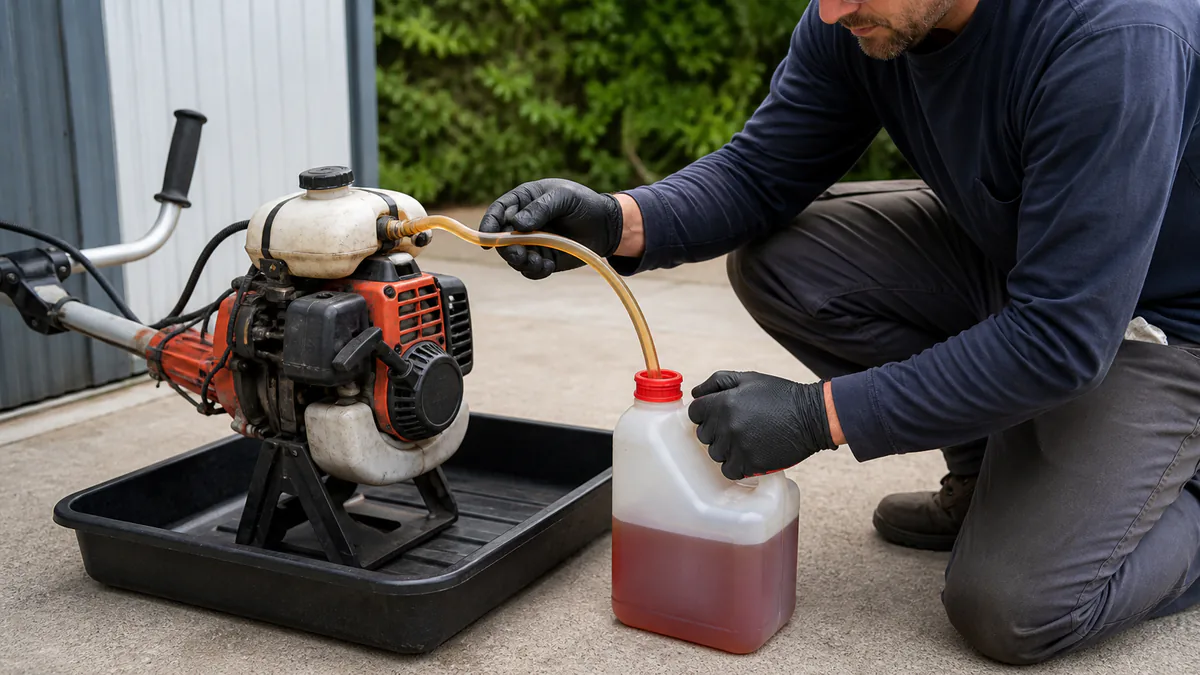
Do not pour contaminated fuel onto soil, into a drain, or into household trash. Use a hazardous-waste service. Work outdoors or in a well-ventilated area, prevent skin and eye contact, contain spills, and allow a hot engine to cool before handling fuel.
An incorrect lubricant may affect coverage for resulting damage. Warranty terms vary, so check the documents for the particular product.
Frequently Asked Questions
What can I use if I run out of two-stroke oil?
Use another purpose-made two-stroke oil only after confirming that its application, certification, and premix or injection approval match the engine manual. If a compatible product is unavailable, leave the engine off. Motor oil and household fluids are not dependable emergency replacements.
Can another brand replace OEM two-stroke oil?
Potentially. Some manuals permit an equivalent lubricant meeting named performance specifications. Compare every required standard and the intended application, not just the viscosity or “2T” wording. During warranty coverage, review the manufacturer’s oil requirements and keep purchase records.
Can I use motor oil instead of two-stroke oil?
No. Automotive motor oil is designed for a circulating crankcase system, not to mix or meter with fuel and burn cleanly. Using it may cause deposits, smoke, plug fouling, poor lubrication, or mechanical damage. Historical SAE recommendations apply only where a particular old manual states them.
Is cooking oil a temporary two-stroke oil substitute?
No. Cooking oils lack verified additives, fuel compatibility, deposit control, and high-speed engine performance. Even castor-based racing lubricants are engineered products, not grocery-store castor oil. Waiting for a suitable two-stroke lubricant is the safer choice.
Can TC-W3 oil replace air-cooled two-stroke oil?
Only if the engine manufacturer specifies or permits TC-W3. It is a marine standard associated with water-cooled two-stroke service. Air-cooled equipment may instead require JASO FD, ISO-L-EGD, or another classification. Similar product names do not make those requirements interchangeable.
Can injector oil be used as premix?
Only when the label and engine documentation approve that use. Injector compatibility addresses flow through a metering system, while premix suitability concerns mixing with gasoline. Some oils support both, but the word “injector” alone does not establish universal premix approval.
Does synthetic oil allow a different mixing ratio?
No. Keep the manufacturer-specified ratio unless official instructions for that exact engine say otherwise. Synthetic base oil may change product characteristics, but it does not independently rewrite the engine’s lubrication requirement. Calculate quantity only after confirming the ratio.
What happens if straight gasoline enters a premix engine?
Straight gasoline deprives a premix-only engine of its intended lubrication. Stop it as soon as safely possible and do not restart after merely adding oil to the tank. The fuel system must contain correctly prepared fuel, and an engine operated under load may require inspection.
Choose by Specification, Not Convenience
The right substitute for 2 stroke oil is not a kitchen product or another fluid that happens to feel slippery. It is a purpose-made two-stroke lubricant proven suitable for the engine’s application, standard, and delivery system.
Find the manual, match the full specification, and preserve the stated ratio. After those decisions are settled, use a mixing calculator to measure accurately. If no compatible oil can be confirmed, keep the engine off until the correct product is available.
Mix with confidence
Calculate your exact oil amount
Choose your fuel volume and required ratio to get a precise premix measurement in US or metric units.
Open the mixing calculatorAbout the author


2 Stroke Dirt Bike Oil: Selection, Premix, and Ratio Guide
Choose the correct 2 stroke dirt bike oil for premix or injection, understand key standards, calculate ratios, and prevent common lubrication mistakes.
Read article
2 Cycle vs 2 Stroke: Engines, Oil, and Fuel Explained
Compare 2 cycle vs 2 stroke engines and oils. Learn why the terms are interchangeable and how to choose the correct oil, standard, and fuel ratio.
Read article
Oil for Two Stroke Engines: How to Choose the Right Type
Learn how to choose oil for two stroke engines by application, oiling system, certification, formulation, and the manufacturer’s required mix ratio.
Read article