
Dirt Bike Maintenance
2 Stroke Dirt Bike Oil: Selection, Premix, and Ratio Guide
Choose the correct 2 stroke dirt bike oil for premix or injection, understand key standards, calculate ratios, and prevent common lubrication mistakes.

The right 2 stroke dirt bike oil is a motorcycle-specific lubricant approved for your bike’s model, year, and lubrication system. A premix bike needs oil designed to be blended with gasoline at its prescribed ratio. A bike with automatic oil injection needs an injector-compatible product. Fuel injection alone does not tell you which arrangement the bike uses.
A fuel-injected motocross bike may still require premixed gasoline, while an enduro model may meter oil from a separate reservoir. The bottle must also satisfy the owner’s manual. Descriptions such as synthetic, ester, or castor cannot establish compatibility alone. This guide covers system identification, oil labels, premix measurement, and troubleshooting.
Quick Answer
Choose motorcycle 2T oil by checking the exact bike model, model year, required performance standard, and lubrication method. Use premix-approved oil only at the specified fuel-to-oil ratio, or injector-compatible oil in an automatic oiling system. Never assume that fuel injection means oil injection, and keep gearbox lubricant separate.
First Identify How Your Bike Receives Oil
A two-stroke motorcycle normally uses a total-loss system for combustion-side lubrication. Oil reaches the crankshaft bearings, connecting rod, piston, rings, and cylinder wall, then burns with the fuel. Delivery depends on the bike.
Premix
With premix lubrication, the rider measures 2T oil into gasoline before filling the tank. Carbureted motocross bikes commonly use this arrangement, but some electronic fuel-injection models also require premix. Their injectors control fuel delivery, not necessarily oil delivery.
Automatic Oil Injection
An oil-injected dirt bike has a separate reservoir, supply line, and metering pump. The system supplies oil according to its design rather than relying on a fixed mixture prepared in a fuel can. Selected enduro and trail models use this approach.
Do not add full premix to an operating injection system unless a model-specific procedure requires it. Extra oil cannot repair a pump, blocked line, or warning condition. Never fill the reservoir with premix-only racing oil unless it carries the required injector approval.
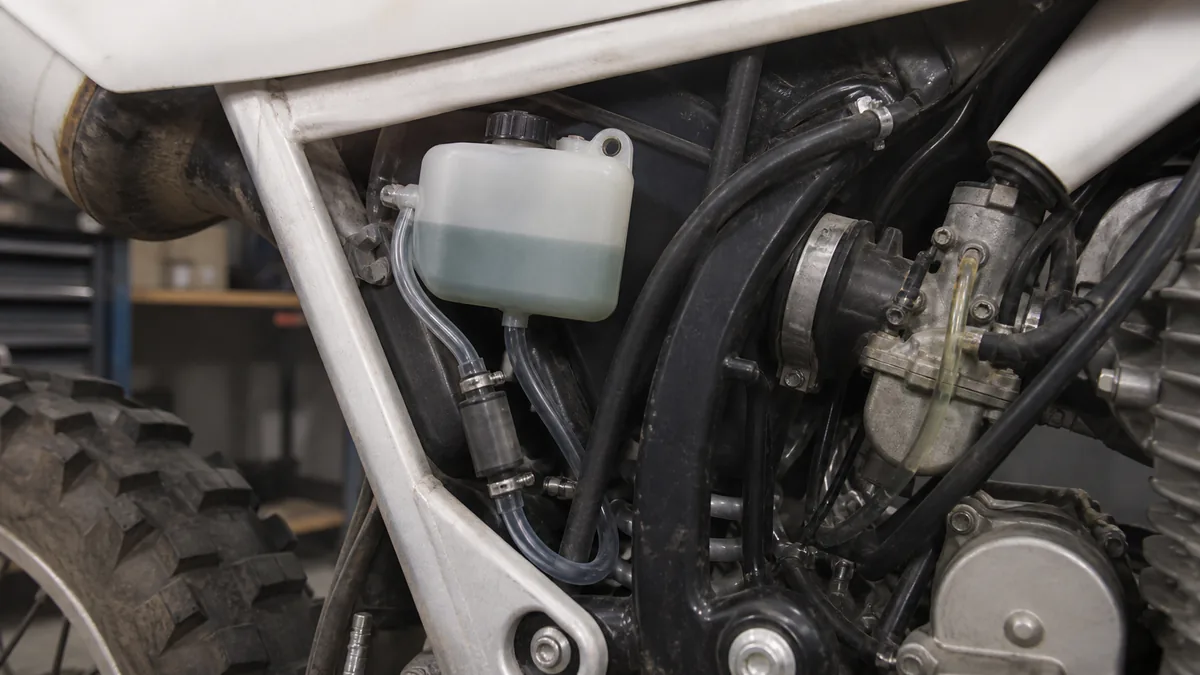
| Dirt bike configuration | What to verify | Frequent error |
|---|---|---|
| Carbureted motocross bike | Premix approval, specification, and factory ratio | Copying a teammate’s mixture |
| Fuel-injected motocross bike | Whether gasoline must still be premixed | Equating fuel injection with oil injection |
| Oil-injected enduro bike | Injector approval and model recommendation | Adding oil to both reservoir and gasoline |
| Youth bike | Exact year and oil-delivery design | Assuming all 50cc bikes work alike |
| Vintage race bike | Original or updated factory guidance | Applying a modern ratio without verification |
| Modified engine | Engine-builder instructions for oil, fuel, and ratio | Relying only on the stock manual |
How to Read Motorcycle 2T Oil Specifications
Recognized performance classifications are more informative than marketing claims because they describe tested characteristics of the finished formula.
JASO M345 covers two-stroke lubricant performance. JASO FC places stronger demands on exhaust smoke and exhaust-system blocking than FB. JASO FD maintains the FC performance framework and raises detergency requirements. Dirt bikes are not universally required to use FD, so match the level printed in the correct manual rather than choosing letters by assumption.
ISO-L-EGC and ISO-L-EGD occupy similar high-performance two-stroke application areas. EGD adds a higher detergency requirement for demanding service. API TC also appears on motorcycle oils and in older manuals, but an API TC claim should not be treated as an automatic substitute when the manufacturer names JASO FD, ISO-L-EGD, or an OEM approval.
NMMA TC-W3 is associated with water-cooled marine two-stroke engines. A dirt bike may also be liquid-cooled, but that does not turn it into an outboard. Cooling architecture, operating temperature, deposits, and duty cycle differ. Use marine oil only when the motorcycle or engine builder expressly permits the product’s approvals.
Some bottles legitimately carry several classifications and support both premix and injection. Check the complete label or product data sheet. A familiar logo, oil color, pleasant exhaust smell, or enthusiastic rider review cannot replace the stated application.
Synthetic, Mineral, Ester, or Castor?
The finished product matters more than one ingredient. There is no universal best 2 stroke dirt bike oil for motocross, technical trails, vintage racing, and automatic injection.
| Formulation | Where it may fit | What to consider |
|---|---|---|
| Full synthetic | Modern high-output engines and clean-running applications | Must still carry the required approval |
| Semi-synthetic | General riding where its complete specification matches | The blend percentage alone says little about performance |
| Mineral | Approved conventional or vintage applications | Do not reject or select it solely because it is mineral |
| Ester-based synthetic | Products designed for demanding motorcycle operation | “Ester” is not a compatibility certificate |
| Castor-based racing oil | Selected competition engines run under suitable conditions | Storage, deposits, temperature, and injection suitability need attention |
| Injector-specific oil | Automatic metering systems | Flow and approval must match the bike and climate |
Synthetic formulas can offer useful film strength, deposit control, or cold-flow performance. They do not authorize a leaner oil ratio. Semi-synthetic and mineral products can also protect correctly when they meet the required standard.
Castor-based oil suits some competition settings, but certain formulas may be unsuitable for long storage, cold conditions, or fine injector passages. Follow product and engine-builder requirements.
Riding style matters only after compatibility is established. A 125cc motocross engine held near peak RPM presents different conditions from a 300cc enduro bike ridden through slow, technical terrain. That difference may influence the manufacturer’s chosen oil and ratio, but displacement alone cannot supply the answer.
Combustion Oil Is Not Gearbox Oil
Most two-stroke dirt bikes also contain a separate transmission and wet clutch. The gearbox lubricant lives in its own compartment and is changed at a service interval. Premix or injector oil lubricates the crankshaft and top end, then burns. These fluids perform different jobs and are not interchangeable.
If a manual lists an engine premix specification and a transmission-oil grade, buy both as directed. Pouring 2T premix oil into the gearbox may fail to provide the clutch and gear performance required. Adding gearbox oil to gasoline can create severe deposits and inadequate engine lubrication. Always identify the filler, drain, fuel tank, and injection reservoir before adding any fluid.
Therefore, a two-stroke still needs gearbox oil changes even though its combustion lubricant is consumed.

Use the Ratio Written for the Bike
The correct 2 stroke dirt bike oil ratio comes from the motorcycle manufacturer or, for a modified engine, the responsible builder. Ratios such as 32:1, 40:1, and 50:1 describe parts of gasoline to one part oil. A larger first number means less oil for the same fuel volume.
Use this formula after confirming the required ratio:
Oil volume = fuel volume ÷ ratio
| Required ratio | Oil for 1 US gallon | Oil for 5 liters |
|---|---|---|
| 32:1 | 4.0 fl oz | 156 ml |
| 40:1 | 3.2 fl oz | 125 ml |
| 50:1 | 2.56 fl oz, often rounded to 2.6 | 100 ml |
The values are calculations, not recommendations. If the manual specifies 40:1, a calculator should help measure 40:1 rather than decide that 50:1 is more convenient. An Imperial gallon is larger than a US gallon, so gallon type must be selected correctly.
Adding extra oil is not a harmless safety margin. In a carbureted premix bike, increasing the oil share leaves less gasoline in each volume of liquid passing through the jets. Without corresponding setup changes, that can alter the effective air-to-gasoline relationship. Smoke and deposits may also increase. Reducing oil below the required amount can weaken the lubrication film and accelerate piston, cylinder, or bearing damage.
A Clean, Repeatable Premix Routine
Once the manual, oil, and ratio are confirmed, consistency matters more than paddock folklore.
- Use fresh gasoline of the grade required by the bike.
- Choose a clean, approved fuel container used only for the intended mixture.
- Measure the actual fuel quantity rather than relying on tank capacity.
- Measure oil with a graduated cup or bottle.
- Add some gasoline to the container, add the oil, and agitate it.
- Add the remaining gasoline and mix again.
- Mark the container with the ratio, fuel type, and preparation date.
- Keep dirt and water away from the cap, funnel, and bike tank.
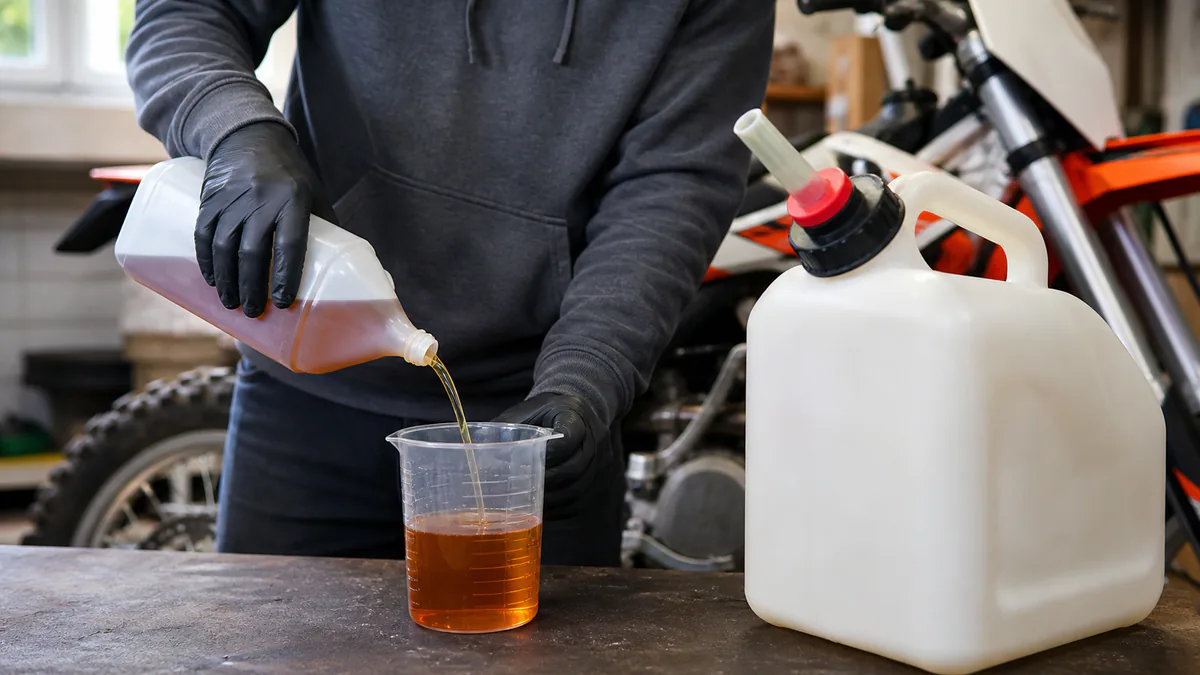
A dirt bike premix calculator can convert the selected fuel amount and ratio into fluid ounces or milliliters. It cannot identify the correct lubricant, account for an unverified engine modification, or diagnose an oil-injection fault.
Do not prepare fuel casually inside the motorcycle tank, where measurement and mixing are harder to confirm. Work with ventilation away from cigarettes, sparks, flames, and hot exhausts. Use suitable protection, control spills, and store fuel under local rules.
Mixed fuel does not remain fresh indefinitely. Ethanol content, heat, moisture, container sealing, and storage duration all affect it. Make quantities you can use within the period stated by the motorcycle, gasoline, and oil suppliers. Stabilizer may slow deterioration when applied correctly, but it cannot repair oxidized or water-contaminated fuel.
Smoke and Spooge Do Not Diagnose the Oil by Themselves
Dark residue at the silencer outlet is commonly called spooge. Too much oil can contribute, but it is only one possibility. Rich carburetor jetting, prolonged low-load riding, an engine that never reaches suitable temperature, worn top-end parts, old silencer packing, unsuitable fuel, or incomplete combustion can produce similar evidence.
A race bike jetted for hard, high-RPM use may load up when ridden slowly for long periods. Simply reducing the oil ratio can sacrifice lubrication without correcting the fuel metering or operating pattern. Diagnose the complete setup instead.
Persistent plug fouling, heavy smoke, or power-valve deposits justify checking:
- the measured ratio and oil specification
- carburetor jetting or fuel-injection condition
- air-filter cleanliness
- spark plug type and ignition health
- piston, rings, and cylinder condition
- exhaust power valve and silencer packing
- fuel freshness and riding pattern
Too little lubrication may show up as abnormal heat, metallic noise, reduced compression, piston scoring, bearing wear, or seizure. If straight gasoline enters a premix bike, stop the engine as soon as safely possible. Do not restart it merely because oil was later poured into the tank. Properly replace or flush the fuel as the service procedure requires, and arrange an inspection if the engine ran under load.
Switching Oil Without Creating New Problems
Changing brands matters less than maintaining the required standard, system approval, and ratio. Compare product data sheets, and do not combine leftovers merely because both bottles say 2T.
For a premix machine, prepare a fresh batch using the replacement oil rather than topping an uncertain container. For an injected model, follow the manufacturer’s procedure for changing products and preventing air from entering the supply line. Never drain, bypass, or bleed a working injection system based solely on a generic tutorial.
After a legitimate change, watch for unusual smoke, throttle response, plug deposits, leakage, or warning indicators. A new symptom deserves investigation, but it does not automatically prove that the new oil caused it. Fuel quality, weather, jetting, maintenance, and mechanical wear may have changed at the same time.
Frequently Asked Questions
What oil does a two-stroke dirt bike use?
It uses motorcycle-specific two-stroke or 2T lubricant meeting the model’s required standard. Premix motorcycles need premix-approved oil at the stated ratio. Automatic oil-injection bikes need an injector-compatible formula. Check the model year because two bikes with the same displacement or brand may use different lubrication systems.
Is synthetic oil better for a two-stroke dirt bike?
Synthetic oil can deliver useful cleanliness, film strength, and temperature performance, but it is not automatically superior for every bike. Certification, premix or injector approval, engine-builder guidance, and operating conditions determine suitability. A compliant semi-synthetic or mineral oil may be entirely appropriate.
Does a fuel-injected two-stroke need premix?
Possibly. Fuel injection controls gasoline delivery, while oil injection meters lubricant. A fuel-injected motocross bike can still require oil mixed into the gasoline. Other models use a separate oil tank and pump. Inspect the manual and the bike’s lubrication hardware instead of inferring the answer from “EFI,” “TPI,” or “TBI” alone.
Can I use marine two-stroke oil in my dirt bike?
Do not use TC-W3 marine oil merely because the motorcycle is liquid-cooled. Marine and off-road motorcycle engines operate under different conditions. The oil is suitable only if its complete approvals satisfy the dirt bike manufacturer’s requirement. A motorcycle-focused JASO or ISO specification is commonly more relevant.
Can I change from 40:1 to 50:1 with synthetic oil?
Not without model-specific authorization. A 50:1 mixture contains less oil than 40:1 for the same gasoline volume. Synthetic base stock alone does not change the required lubricant supply. Follow the factory or engine-builder ratio and correct jetting separately when necessary.
Is exhaust spooge caused by too much premix oil?
It can contribute, but spooge is not a ratio test. Rich jetting, low combustion temperature, slow riding, stale fuel, worn parts, ignition trouble, and saturated silencer packing can all create residue. Confirm the measured mixture, then diagnose fuel metering, mechanical condition, exhaust maintenance, and riding conditions.
Can the same oil lubricate the engine and gearbox?
Normally, the consumed 2T oil and retained gearbox lubricant are separate products. Premix or injected oil protects the crankshaft and top end before burning. Gearbox oil serves the transmission and wet clutch. Use each fluid specified in the manual and place it only in the correct location.
How long can dirt bike premix be stored?
No single storage period fits every fuel. Ethanol level, temperature, moisture, container quality, and supplier guidance affect freshness. Mix manageable batches, date each sealed container, and keep it in an approved storage area. Dispose of questionable fuel through an appropriate local facility rather than trying to improve it with extra oil.
Choose With the Bike in Front of You
The safest buying sequence is simple: record the model and year, determine premix or automatic injection, read the exact oil specification, and check that the bottle supports the required delivery method. Then retain the prescribed ratio and calculate only the quantity you need.
Good 2 stroke dirt bike oil selection is not a popularity contest between colorful bottles. It is a compatibility decision tied to a particular engine and use. Correct oil, accurate mixing, clean fuel handling, and separate gearbox maintenance give the piston, bearings, power valve, clutch, and transmission the conditions their designers intended.
Mix with confidence
Calculate your exact oil amount
Choose your fuel volume and required ratio to get a precise premix measurement in US or metric units.
Open the mixing calculatorAbout the author

2 Cycle vs 2 Stroke: Engines, Oil, and Fuel Explained
Compare 2 cycle vs 2 stroke engines and oils. Learn why the terms are interchangeable and how to choose the correct oil, standard, and fuel ratio.
Read article
Substitute for 2 Stroke Oil: What Is Actually Safe?
Learn what qualifies as a safe substitute for 2 stroke oil, which household fluids to avoid, and how to match oil standards, systems, and ratios.
Read article
Oil for Two Stroke Engines: How to Choose the Right Type
Learn how to choose oil for two stroke engines by application, oiling system, certification, formulation, and the manufacturer’s required mix ratio.
Read article