
Oil Selection
Oil for Two Stroke Engines: How to Choose the Right Type
Learn how to choose oil for two stroke engines by application, oiling system, certification, formulation, and the manufacturer’s required mix ratio.

Choosing oil for two stroke equipment begins with the engine, not the brand on the bottle. Use a purpose-made two-stroke, two-cycle, or 2T lubricant that meets every specification in the correct owner’s manual. Air-cooled tools often call for a JASO or ISO performance level, while many water-cooled outboards require NMMA TC-W3 oil.
Two-stroke lubricant enters through premixed fuel or an injection system. It must lubricate internal parts, control deposits, and burn during operation. Formulas made for different temperatures or duties are not automatically interchangeable. Before buying, identify the model and year, application, certification, delivery system, and fuel-to-oil ratio. Those facts matter more than color, price, or the word “synthetic.”
Quick Answer
The correct two-stroke oil is the product that matches the engine manual’s application, performance standard, oil-delivery system, and mixing ratio. Air-cooled equipment commonly specifies JASO or ISO performance, whereas many outboards require NMMA TC-W3. Full synthetic, semi-synthetic, or mineral base oil alone does not prove compatibility.
Begin With the Engine, Not the Bottle
“Two-stroke,” “two-cycle,” and “2T” describe the same basic engine cycle and are common oil-label variations. They do not mean every bottle suits every two-stroke engine. A chainsaw works at high speed and temperature with air cooling. An outboard normally operates under water-cooled marine conditions and faces corrosion concerns. A snowmobile may need reliable flow during a cold start. A road motorcycle can have requirements that differ from all three.
Locate the model number and year, then find the matching manual and any manufacturer updates. Establish whether the engine uses premix or automatic oil injection. If the manual is missing, obtain reliable model-specific information instead of copying a similar-looking machine.
Use this application table as a search guide, never as a replacement for the manual.

| Engine application | Oil information to confirm | Mistake to avoid |
|---|---|---|
| Chainsaw, trimmer, or blower | Required JASO or ISO rating for air-cooled service | Buying marine oil only because it says two-stroke |
| Dirt bike or motorcycle | Performance standard plus premix or injection approval | Confusing engine lubricant with separate gearbox oil |
| Scooter or moped | Injector-pump compatibility or specified premix use | Assuming every 2T formula flows properly in every system |
| Snowmobile | Low-temperature properties and manufacturer approval | Selecting by synthetic content alone |
| Outboard motor | Required marine certification, commonly NMMA TC-W3 | Substituting air-cooled oil without approval |
| Vintage engine | Original or officially updated model requirement | Applying 50:1 to every older engine |

What the Certification Codes Actually Tell You
Certification is more useful than claims such as “premium” or “maximum protection.” Match the full code printed in the manual, including its performance level.
JASO M345 classifications are widely used, especially for air-cooled applications. JASO FB covers lubricity, detergency, exhaust smoke, and exhaust-system blocking. FC raises smoke and exhaust-system cleanliness requirements. FD adds greater detergency demands than FC while retaining other controls. A manual requiring FD needs that level, not merely an oil advertised as low smoke.
ISO two-stroke classifications include ISO-L-EGC and ISO-L-EGD. They broadly align with the application space represented by JASO FC and FD, with ISO-L-EGD providing stronger detergency demands for severe conditions. Follow the precise specification named by the engine maker rather than treating every letter code as a ranking across unrelated engine types.
NMMA TC-W3 certifies water-cooled marine lubricants. Testing addresses lubricity, fluidity, fuel mixing, rust, ring sticking, and deposits. TC-W3 is not a universal upgrade over an air-cooled specification, and air-cooled 2T oil is not automatically right for an outboard.
API TC appears on some products and in older literature. It may provide useful supporting information, but it should not be assumed to replace a manual’s more specific JASO, ISO, or marine requirement. A product carrying several legitimate approvals can suit multiple applications, provided every requirement for the particular engine is covered.
Base Oil Is Only Part of the Formula
Shoppers often reduce the choice to synthetic versus mineral. Base stock matters, but additives, performance testing, viscosity behavior, and system approval also determine whether an oil is suitable.
| Oil type | General characteristic | Selection limitation |
|---|---|---|
| Full synthetic | Can provide strong film performance and controlled deposits | Not automatically needed or compatible with every engine |
| Semi-synthetic | Blends synthetic and mineral base stocks | Quality depends on the complete tested formulation |
| Mineral | Conventional base stock used in approved oils and older applications | Must still meet the stated engine specification |
| Castor-based racing oil | Intended for selected high-load competition uses | May be unsuitable for storage, injection, or routine equipment |
| Ashless marine oil | Common approach in certified water-cooled marine products | Does not replace an air-cooled specification without approval |
| Low-ash air-cooled oil | Designed around relevant hot-running engine conditions | Not automatically appropriate for an outboard |
Full synthetic oil may offer useful cleanliness, cold-flow, or film characteristics. Semi-synthetic oil can also deliver verified performance. Mineral oil remains correct where it meets the prescribed standard. No base-oil label overrides the manual.
“Ashless” and “low ash” describe different additive approaches, not good-versus-bad grades. Marine and air-cooled engines have different deposit-control needs. Castor-based racing oil can present storage, cleanliness, or injection concerns outside its intended setting.
Oil color offers no dependable guidance. Manufacturers add dye to aid identification, so red, blue, green, or amber fluid does not establish its standard, formulation, or compatibility.
Premix and Injection Need Separate Checks
In a premix engine, the user measures oil into gasoline before the fuel reaches the engine. An oil-injected or autolube engine stores lubricant separately and meters it through a pump. Some products are approved for both methods, while others have narrower intended use.
For injection, confirm suitability for the system, temperature, and model. Flow matters in cold service, but an “all-season” claim does not replace approval. Never put premix-only oil in a reservoir unless both label and manual permit it.
For premix, compatibility comes before quantity. The oil must meet the specification, and the ratio must come from the manufacturer. A costly or synthetic formula does not authorize changing 40:1 to 50:1. The ratio controls lubricant delivery and remains an engine requirement.
A Practical Oil-Label Checklist
Before paying, compare the container with the manual line by line. Confirm:
- The product is purpose-made two-stroke engine oil.
- The stated application includes the relevant equipment category.
- Every required JASO, ISO, API, NMMA, or manufacturer specification appears.
- The oil is approved for premix, injection, or both, as needed.
- Temperature or fuel restrictions suit expected use.
- Mixing directions do not conflict with the engine’s prescribed ratio.
- The container is sealed, legible, and within any stated storage guidance.
Do not confuse motorcycle premix oil with crankcase or gearbox lubricant. Some two-stroke motorcycles use separate transmission oil, but it does not lubricate the combustion side. Automotive motor oil, bar oil, and household oils are not substitutes.
If a label provides no recognizable standard or application approval, keep looking. Certification and compatibility outweigh scent, dye, packaging, or brand familiarity.
Calculate Quantity Only After Confirming Compatibility
Once the correct oil and ratio are known, calculate the quantity. The basic formula is:
Oil required = fuel volume ÷ fuel-to-oil ratio
For a 50:1 mix using one US gallon, convert the gallon to 128 fluid ounces:
128 ÷ 50 = 2.56 fluid ounces of oil
This is commonly measured as 2.6 fluid ounces per US gallon. In metric units, 50:1 requires 20 milliliters per liter. An Imperial gallon is larger than a US gallon, so do not apply the US-fluid-ounce quantity to an Imperial gallon.
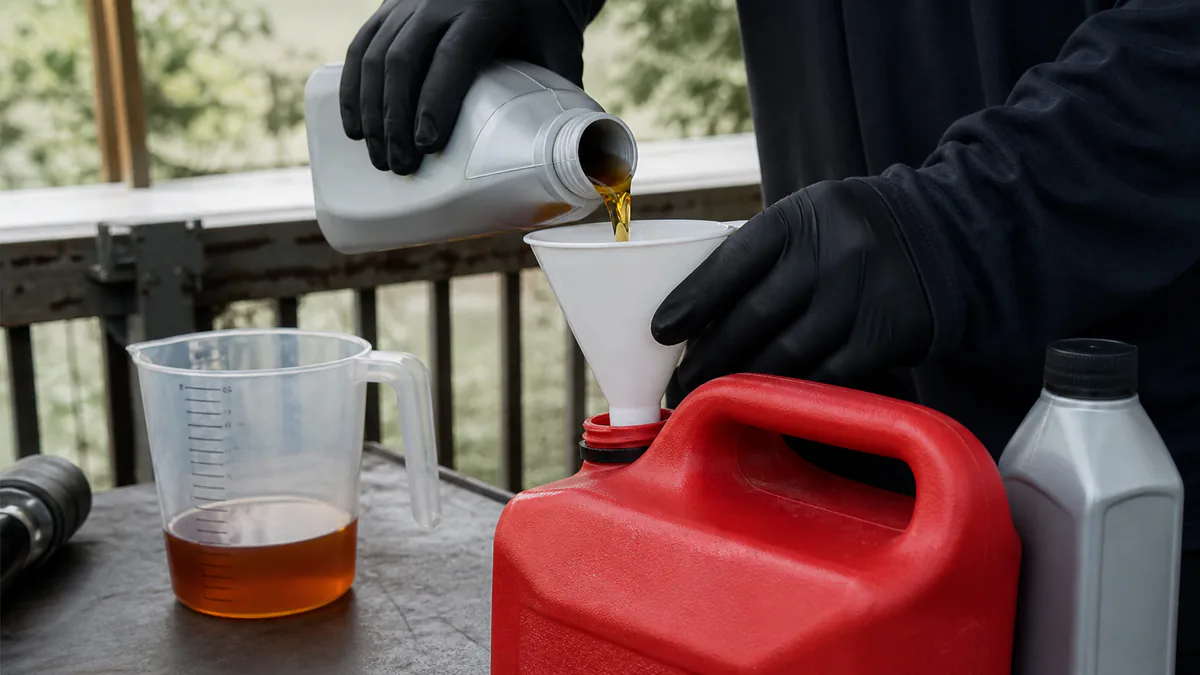
An oil-mixing calculator reduces arithmetic errors but cannot choose the product. Enter the confirmed ratio and fuel volume after checking the manual. Measure with a graduated container and mix in an approved fuel can. Gasoline, or petrol, is highly flammable, so work with ventilation away from heat, sparks, and flames.
When the Oil Choice or Quantity Is Wrong
Excessive smoke does not prove that the oil brand is poor. Too much oil, stale fuel, restricted airflow, carburetion problems, prolonged idling, or an engine fault can create similar symptoms. An unsuitable product or overly oil-rich mixture may contribute to spark plug fouling, carbon deposits, exhaust-port restriction, rough running, and oily residue.
Too little suitable oil is more dangerous. Inadequate lubrication can raise friction and temperature, leading to piston or cylinder scoring, bearing damage, loss of compression, or seizure. Straight gasoline can quickly damage a premix engine. Stop it as soon as safely possible and do not assume that adding oil afterward reverses wear already caused.
If symptoms begin after changing oil, verify the specification, ratio, measurements, and fuel freshness. Do not correct an uncertain mixture by guessing. Dispose of questionable fuel under local rules, then prepare a verified batch. Persistent smoke, overheating, noise, or power loss warrants inspection.
Operating conditions also refine the choice. High engine speed, sustained load, winter starting, and long storage can expose different lubricant weaknesses. Check any temperature limits and fuel guidance in the manual. For older equipment, follow model-specific instructions rather than assuming modern oil permits a leaner mixture or a newer ratio.
Frequently Asked Questions
What type of oil does a two-stroke engine use?
Use purpose-made two-stroke, two-cycle, or 2T oil matching the manual’s standard and application. It may require an air-cooled JASO or ISO rating, NMMA TC-W3 marine certification, or specialized approval. Delivery method and ratio must also match.
Is full synthetic two-stroke oil always better?
No. Full synthetic oil can offer useful film strength, cleanliness, or cold performance, but only when the formulation meets the engine requirement. A certified semi-synthetic or mineral product may be correct. Compare specifications before base-oil descriptions.
Can marine two-stroke oil be used in a chainsaw?
Not merely because both are two-stroke. Many outboards specify TC-W3 for water-cooled service, while chainsaws often require an air-cooled JASO or ISO level. Use marine oil only if it carries every approval required for the chainsaw.
Can chainsaw oil be used in an outboard motor?
Not unless the outboard’s instructions permit its certifications. Many outboards require NMMA TC-W3. Chainsaw bar oil lubricates the cutting bar and chain; it must never enter outboard fuel.
Does synthetic oil let me use a leaner fuel-to-oil ratio?
No. Keep the manufacturer-specified ratio unless the engine maker issues model-specific guidance. Synthetic content does not change the requirement. Moving from 40:1 to 50:1 supplies less oil and could cause inadequate lubrication.
What is the difference between premix and injector oil?
Premix oil is measured into gasoline. Injector oil enters a reservoir and flows through automatic metering. Some products support both methods, but approval must appear on the label and satisfy the manual.
Why is my two-stroke engine smoking after an oil change?
Verify the specification and ratio. Check for stale fuel, restricted airflow, carburetor trouble, extended idling, or deposits. Smoke alone cannot identify the cause. Continued fouling, poor running, or overheating needs diagnosis.
How long can mixed two-stroke fuel be stored?
No universal period applies because fuel, ethanol content, container quality, temperature, and moisture vary. Mix manageable quantities, date and close the approved container, follow product guidance, and dispose of questionable premix responsibly.
Make the Selection in the Right Order
Successful oil selection is a sequence: identify the model and year, read the correct manual, classify the application, confirm premix or injection, match every required standard, and retain the specified ratio. Only then should you calculate volume.
The right oil for two stroke service is therefore not a universal brand or base stock. It is the certified product approved for that particular engine and operating system. A careful label check, accurate measurement, fresh fuel, and proper storage protect the piston, cylinder wall, bearings, exhaust system, and the reliability of the machine.
Mix with confidence
Calculate your exact oil amount
Choose your fuel volume and required ratio to get a precise premix measurement in US or metric units.
Open the mixing calculatorAbout the author


Best Two Stroke Oil: How to Choose the Right 2T Oil
Find the best two stroke oil for chainsaws, dirt bikes, outboards, and injected engines. Compare oil types, standards, compatibility, and uses.
Read article
2 Stroke Dirt Bike Oil: Selection, Premix, and Ratio Guide
Choose the correct 2 stroke dirt bike oil for premix or injection, understand key standards, calculate ratios, and prevent common lubrication mistakes.
Read article
2 Cycle vs 2 Stroke: Engines, Oil, and Fuel Explained
Compare 2 cycle vs 2 stroke engines and oils. Learn why the terms are interchangeable and how to choose the correct oil, standard, and fuel ratio.
Read article