
Marine Engines
Evinrude 2 Stroke Oil Mixture: Ratios, Chart, VRO, and E-TEC Guidance
Find the correct Evinrude 2 stroke oil mixture, use the 50:1 chart, and learn how ratios differ for vintage, VRO, FICHT, and E-TEC motors.

The correct Evinrude 2 stroke oil mixture depends on the outboard’s model year and lubrication system. Many conventional 1964-and-newer premix models commonly use 50:1, equal to 2.6 fluid ounces of oil per US gallon of gasoline. Earlier engines may require 20:1 or 24:1, while a working VRO, OMS, FICHT, or E-TEC oil-injection system follows a different procedure. Do not choose a ratio from horsepower alone. Two Evinrude outboards with the same horsepower can have different model years, internal designs, and oiling systems. Before adding oil, find the engine model number, identify whether it uses premix or automatic oil injection, and consult the correct operator’s or service manual. That short check can prevent excessive smoke, spark plug fouling, inadequate lubrication, or permanent powerhead damage.
Quick Answer
Many conventional 1964-and-newer premix Evinrude outboards commonly use a 50:1 gasoline-to-oil ratio, or 2.6 fluid ounces of marine two-stroke oil per US gallon. Pre-1964 motors and oil-injected VRO, FICHT, or E-TEC engines may require different procedures. Verify the model year, oiling system, and factory manual before mixing.
Which Evinrude Engines Need Premixed Fuel?
An Evinrude two-stroke receives oil in one of several ways. Identifying the system is more reliable than guessing from the engine’s age or horsepower.
Conventional premix outboards
A conventional premix motor has no separate oil reservoir or functioning automatic oil-injection system. Its oil must be measured into the gasoline before the fuel reaches the engine. Many carbureted Evinrude outboards in this category use 50:1, but vintage engines can require a richer oil mixture. “Richer” in this context means more oil relative to gasoline, such as 24:1 instead of 50:1.
VRO and OMS oil-injected outboards
VRO stands for Variable Ratio Oiling. Later versions are often described as an Oil Metering System, or OMS. These systems draw gasoline and oil separately, then meter oil according to operating conditions. If the oil-injection system is installed, correctly primed, and operating as designed, do not automatically add a full premix dose to the gasoline. Follow the model-specific manual or a qualified marine technician’s procedure. Adding 50:1 premix while the pump is also supplying oil can result in double oiling, heavy smoke, fouled plugs, carbon deposits, and poor running. A separate oil tank does not prove that the system works. Its hoses, primer, pump, warning circuit, and oil flow must be in serviceable condition.
FICHT and Evinrude E-TEC outboards
FICHT and E-TEC are direct-injection designs with dedicated oil-delivery systems. An Evinrude E-TEC normally does not use manually prepared 50:1 gasoline during routine operation. BRP operator guides direct owners to fill the oil reservoir with an approved product. Depending on the model and Engine Management Module setting, recommended oils may include Evinrude/Johnson XD30, XD50, or XD100. Some E-TEC engines can be programmed by an authorized dealer for exclusive XD100 use and reduced oil consumption. If programmed for XD100, the applicable guide warns against switching oils without the required reprogramming procedure. Do not use premix as a substitute for diagnosing a low-oil or no-oil alarm. Special break-in, priming, emergency, or service procedures must come from the correct manual.
Evinrude 2 Stroke Oil Mixture Chart for 50:1
At 50:1, every 50 units of gasoline require one unit of oil by volume. Oil required = fuel volume ÷ ratio One US gallon contains 128 fluid ounces: 128 fl oz ÷ 50 = 2.56 fl oz That is normally rounded to 2.6 fluid ounces of oil per US gallon.
| Fuel quantity | Oil required at 50:1 |
|---|---|
| 1 US gallon | 2.6 fl oz |
| 2 US gallons | 5.1–5.2 fl oz |
| 3 US gallons | 7.7 fl oz |
| 5 US gallons | 12.8 fl oz |
| 6 US gallons | 15.4 fl oz |
| 1 liter | 20 ml |
| 5 liters | 100 ml |
| 10 liters | 200 ml |
| 20 liters | 400 ml |
| The traditional shortcut of one US pint of oil to six US gallons of gasoline is common in older outboard guidance. A US pint contains 16 fluid ounces, while the exact 50:1 amount for six gallons is 15.36 ounces. Therefore, one pint in six gallons produces approximately 48:1—close to 50:1 but not mathematically exact. |
US gallons and Imperial gallons are different
A US gallon contains 128 US fluid ounces. An Imperial gallon is larger, at approximately 4.546 liters versus 3.785 liters for a US gallon. At 50:1:
- One US gallon requires about 2.6 US fluid ounces of oil.
- One Imperial gallon requires about 90.9 ml, or approximately 3.2 Imperial fluid ounces. Do not apply a US-gallon measurement to an Imperial gallon. Using liters and milliliters avoids this regional ambiguity: 20 ml of oil per liter of gasoline produces 50:1.
Historical Ratios for Older Evinrude Outboards
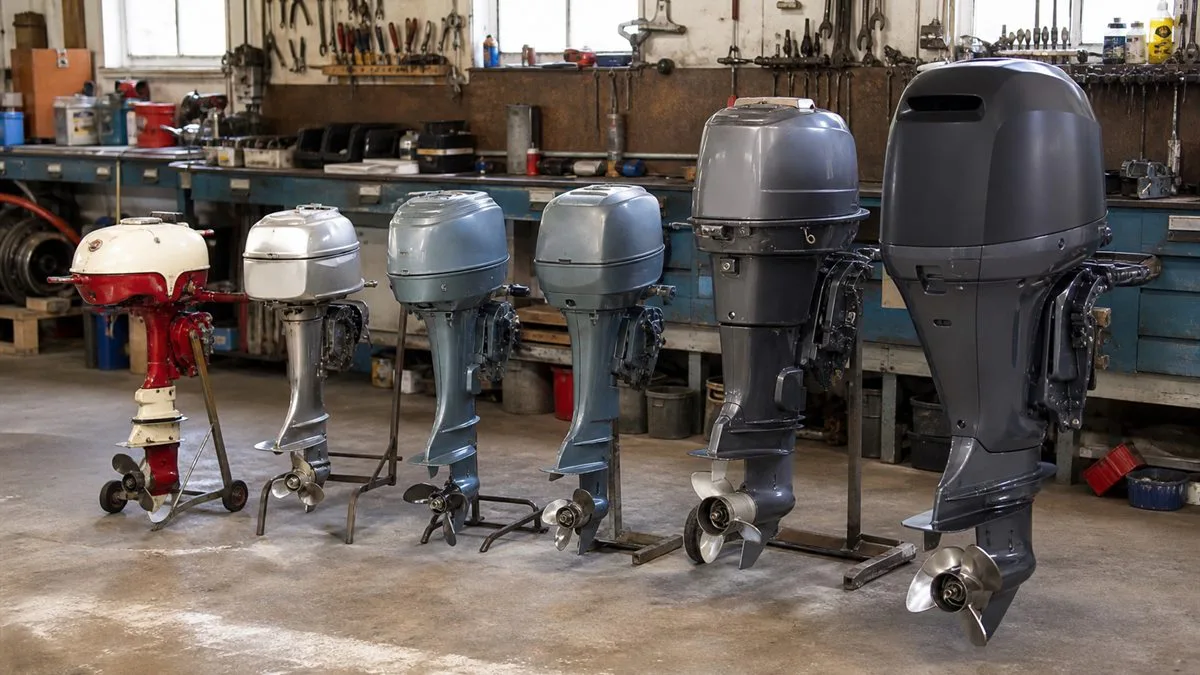
Published Johnson and Evinrude reference material is commonly summarized by model era, but this chart is only a starting point. Individual models, transition-year engines, commercial use, racing applications, and special break-in instructions can differ.
| General model-era reference | Commonly cited ratio |
|---|---|
| 1958 and earlier | 20:1 |
| 1959–1963 | 24:1 |
| Many 1964-and-newer conventional premix models | 50:1 |
| Certain historical break-in procedures | 25:1 |
| Some engines historically labeled 100:1 | Verify updated factory guidance before use |
| MarineEngine’s summary of earlier Evinrude guidance lists 20:1 for 1958 and earlier, 24:1 for 1959 through 1963, and 50:1 for many 1964-and-newer engines. It also notes that a working VRO system meters the oil rather than requiring routine premixing. | |
| Treat 1964 carefully because it was a transition period. Confirm the model number and factory literature rather than relying only on the year printed on a boat registration. | |
| Some older engines used sleeve or plain bearing arrangements that depended on more oil than later roller-bearing designs. Modern lubricant quality does not automatically authorize changing a 24:1 vintage engine to 50:1. The engine’s construction and factory requirements still matter. | |
| Historical 100:1 recommendations also need caution. Some Evinrude and Johnson manuals or decals identified 100:1 for particular engines, but later marine-service guidance often returned those motors to 50:1, partly because a very lean oil mixture provided less internal corrosion protection during storage. Do not choose between 100:1 and 50:1 from a forum comment. Find the applicable manual, service bulletin, or advice from a technician familiar with that model. |
What Oil Should an Evinrude Two-Stroke Use?
For a conventional water-cooled Evinrude outboard, select marine two-stroke oil carrying the certification required by its manual. For many models, that means NMMA TC-W3-certified oil. TC-W3 is a performance-based oil certification administered by the National Marine Manufacturers Association. Qualification includes bench testing for properties such as fluidity, miscibility, rust protection, and compatibility, plus engine testing related to ring sticking and carbon buildup. Oil does not always need Evinrude branding to be suitable for an older premix motor. An approved Quicksilver, Pennzoil Marine, or another genuine TC-W3-certified product may be acceptable when it meets the manual’s requirements. Check for the certification on the container rather than relying on a vague “marine” description. Never substitute:
- Automotive four-stroke motor oil
- Chainsaw bar-and-chain oil
- Oil intended only for an air-cooled trimmer or chainsaw
- A product with no required marine certification
- An unknown mixture left in an unmarked container A water-cooled marine engine operates under different conditions from an air-cooled outdoor power tool. Both may be two-stroke engines, but their lubricant specifications are not automatically interchangeable.
XD30, XD50, and XD100 are not universally interchangeable
Evinrude XD30, XD50, and XD100 were designed for different performance levels and applications. XD100 is a synthetic formula associated particularly with E-TEC engines, deposit control, low-temperature performance, and compatible EMM programming. A BRP E-TEC guide states that the outboard can be dealer-programmed for XD100 to reduce oil consumption. Another guide specifies that an engine programmed for exclusive XD100 use must be returned to a dealer for reprogramming before permanently switching away from it. The safest question is not simply “Which oil is best?” It is: Which oil does this model and its current oil-system setting require?
How to Mix Gas and Oil for a Premix Evinrude
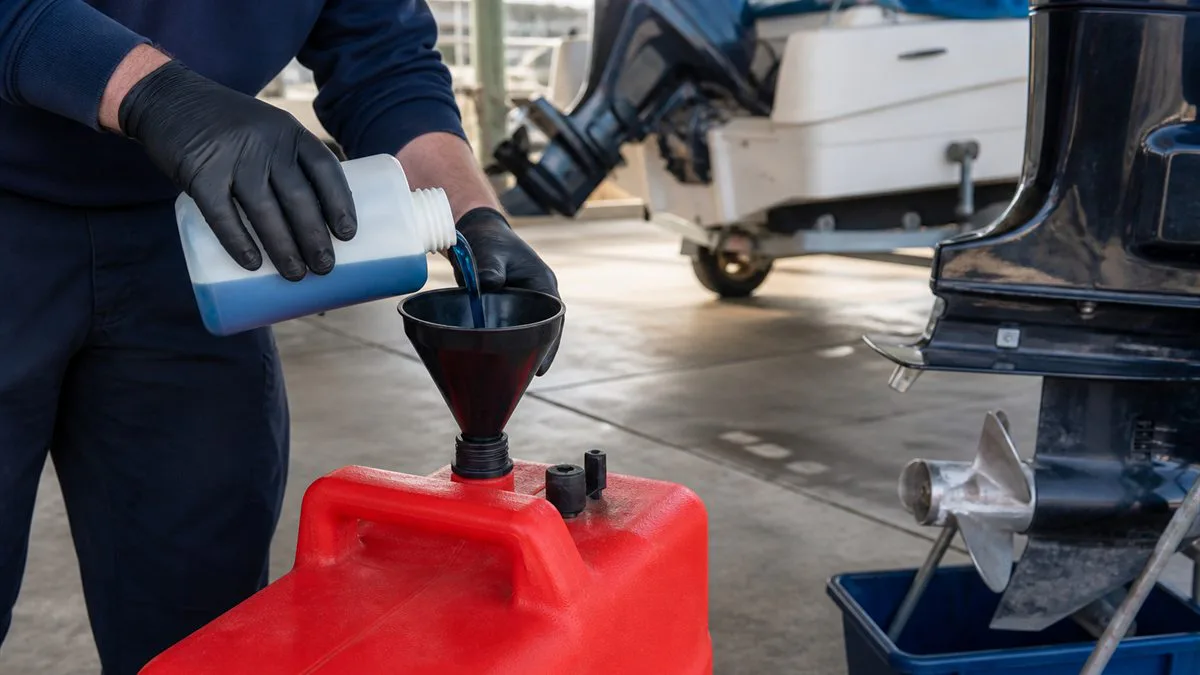
Use this process only after confirming that the motor is a premix model and identifying the specified ratio.
- Verify the model and ratio.
Check the identification plate, operator’s manual, or model-specific service information. Horsepower alone is not enough. - Work in a ventilated area.
Mix outdoors, away from cigarettes, flames, heaters, sparks, batteries being charged, and hot engine components. - Use a clean approved fuel container.
Do not use a container contaminated with water, dirt, diesel, or an unknown fuel mixture. - Add part of the gasoline.
Pouring roughly half the required gasoline into the container first helps the measured oil disperse. - Measure and add the marine oil.
Use a graduated bottle or measuring cup resistant to petroleum products. For one US gallon at 50:1, add 2.56 ounces, normally rounded to 2.6 ounces. - Close and agitate the container.
Secure the cap and mix the contents thoroughly. - Add the remaining gasoline.
Close the can and agitate it again before transferring fuel to the outboard tank. - Label and date the container.
Mark the fuel as two-stroke premix and record the ratio. This prevents accidental use in a four-stroke engine or confusion with straight gasoline. Wear fuel-resistant gloves and eye protection where splashing is possible. Let a hot motor cool before refueling, avoid overfilling, and clean spills according to the product instructions and local environmental rules. Pouring gasoline and oil separately into a built-in tank can produce uneven mixing, especially when the tank already contains an unknown amount of fuel. Preparing the mixture in a portable container gives you better control over both measurement and blending.
VRO Conversion and Premix Safety
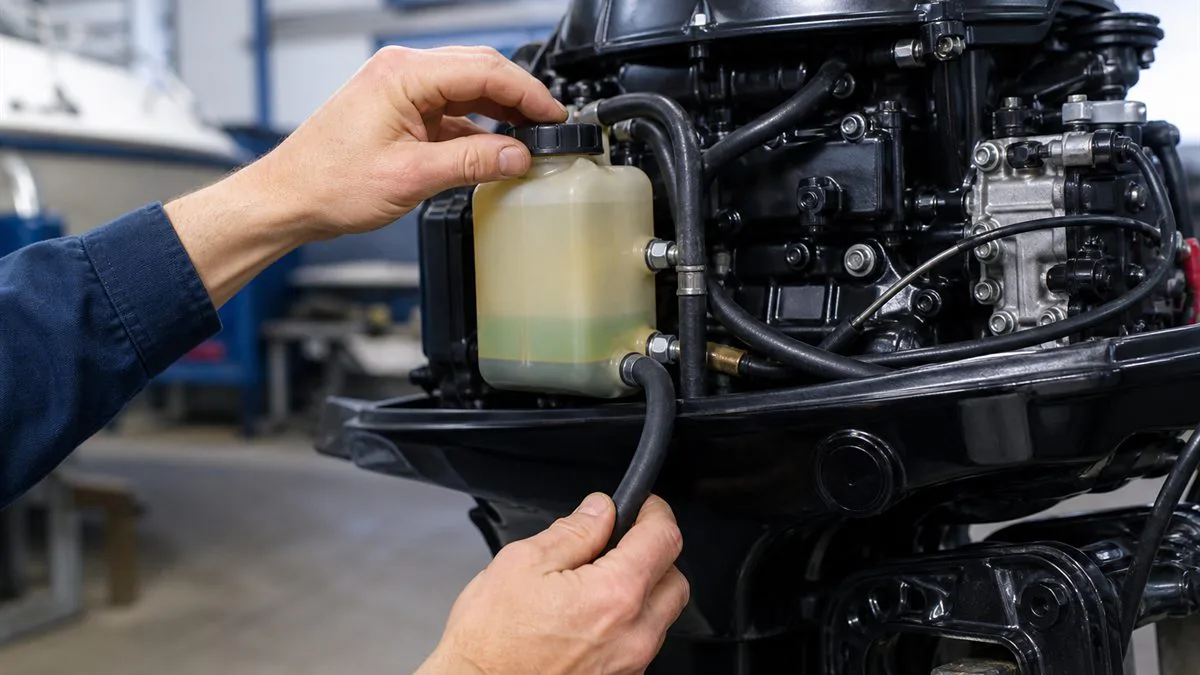
Owners sometimes consider a VRO delete because of an oil-system fault or concern about an older pump. Removing or bypassing it is not simply a matter of disconnecting the oil hose and adding oil to the fuel. The conversion can affect:
- Fuel-pump operation
- Oil supply and air entry
- Warning circuits and alarms
- Oil-line connections
- Priming procedures
- Fuel delivery
- Break-in or verification procedures After a professionally completed conversion, many conventional engines use a model-specified premix—often 50:1—but that ratio must be verified. The fuel system must also be filled with correctly mixed fuel before the engine is operated. Do not disable a working VRO or OMS system from a generic video or forum post. A qualified marine technician can test oil consumption, inspect hoses, confirm alarm operation, and determine whether repair or conversion is appropriate.
Gasoline Quality, Storage, and Ethanol
Fuel requirements vary by model, year, and country. Consult the operator’s manual for minimum octane and permitted ethanol content rather than applying a current E-TEC specification to a vintage carbureted engine. Use fresh gasoline and keep it in a sealed, approved container. Ethanol-blended fuel can absorb moisture, and prolonged storage may contribute to water contamination, phase separation, deposits, or deterioration of older fuel-system components. Ethanol-free gasoline may be useful where available and approved, but it does not eliminate the need for proper storage. A fuel stabilizer can slow oxidation when added to fresh gasoline. It cannot restore fuel that is already stale, contaminated, or phase-separated. Avoid preparing more premix than you can use within a reasonable period. Mark the mixing date and follow the oil, stabilizer, and engine manufacturer’s storage guidance. Take unwanted gasoline or premix to an approved hazardous-waste or fuel-recycling facility; never pour it into water, soil, drains, or household trash.
Symptoms of an Incorrect Oil Mixture
Too much oil
An oil-rich mixture can cause:
- Heavy blue exhaust smoke
- Oily residue around the exhaust
- Spark plug fouling
- Carbon deposits
- Rough idle
- Hard starting
- Reduced power Extra oil does not compensate for worn bearings, poor compression, overheating, or a faulty lubrication system.
Too little oil
An oil-lean mixture may result in:
- Inadequate piston and bearing lubrication
- Excessive operating temperature
- Piston or cylinder scoring
- Bearing damage
- Reduced compression
- Engine seizure
- Permanent powerhead damage Stop the motor if you suspect it received straight gasoline or substantially under-oiled fuel. Bogging does not prove that the gas-to-oil ratio is wrong. Restricted fuel flow, a dirty carburetor, blocked tank vent, weak ignition, poor compression, incorrect link-and-sync adjustment, contaminated fuel, or a damaged propeller can produce similar symptoms.
What to Do After Accidentally Using Straight Gas
If a premix Evinrude has operated without oil:
- Stop the engine as soon as it is safe to do so.
- Do not restart it merely after pouring oil into the tank.
- Remove or isolate the incorrect gasoline as appropriate.
- Ensure the tank, fuel line, primer bulb, pump, and carburetors receive correctly mixed fuel before operation.
- Arrange professional inspection if the engine ran under load or developed noise, overheating, loss of power, or compression problems. Simply adding extra oil later cannot reverse scoring or bearing damage. A marine technician may need to inspect the spark plugs, compression, cylinders, and lubrication system before the outboard is used again.
Frequently Asked Questions
What ratio should an Evinrude two-stroke use?
Many conventional 1964-and-newer premix motors commonly use 50:1. Earlier engines may specify 20:1 or 24:1, while VRO, FICHT, and E-TEC models use separate oiling procedures. Confirm the model year, engine number, and lubrication system in the correct factory manual.
How much oil is needed per gallon at 50:1?
One US gallon requires 2.56 fluid ounces of oil at exactly 50:1, normally rounded to 2.6 fluid ounces. In metric units, use 20 milliliters per liter. Confirm that the engine requires 50:1 and use the specified marine two-stroke oil.
Does an Evinrude VRO need premixed gas?
A correctly installed, primed, and functioning VRO system normally meters oil automatically, so routine full-strength premix is not generally added. Special priming, break-in, testing, or conversion procedures may differ. Follow the model-specific manual or a qualified technician’s directions.
Does an Evinrude E-TEC use premix?
An E-TEC normally uses electronically controlled oil injection rather than manually mixed 50:1 fuel. Oil is placed in its separate reservoir. Approved oil and EMM settings vary by model, so do not use premix to address an alarm or substitute oils without checking the operator’s guide.
Can I use any TC-W3 oil in an Evinrude?
Many conventional Evinrude outboards accept an NMMA-certified TC-W3 oil, but “any” is too broad. Direct-injection and E-TEC models may have more specific oil requirements or programming. Match the oil to the manual and current engine configuration.
What ratio does a vintage Evinrude use?
Common historical references suggest 20:1 for many 1958-and-earlier motors and 24:1 for many 1959–1963 motors. However, exceptions exist, and 1964 was a transition period. Use the model number to locate the correct manual before preparing a vintage Evinrude fuel mixture.
What happens if too much oil is added?
Excessive oil can produce heavy smoke, oily exhaust residue, fouled plugs, carbon buildup, rough running, and reduced power. Do not dilute an unknown mixture by estimation. Calculate what was added accurately or replace it with a verified batch.
Will straight gas ruin an Evinrude two-stroke?
Straight gasoline can quickly damage a premix engine because the crankshaft, bearings, piston, and cylinder depend on oil carried in the fuel. Stop the engine immediately and do not restart it until the fuel system contains the proper mixture. Seek inspection if it ran under load.
Confirm the Engine Before Choosing a Ratio
BRP discontinued Evinrude E-TEC and E-TEC G2 production in May 2020, although it continued supporting the installed engine base with service parts. That makes model identification and original documentation especially valuable for current owners. Before preparing an Evinrude 2 stroke oil mixture:
- Find the engine model number and model year.
- Determine whether it uses premix, VRO/OMS, FICHT, or E-TEC oil injection.
- Locate the correct operator’s or service manual.
- Select the specified marine oil.
- Measure the required ratio accurately. A 50:1 mix is common, but the correct answer belongs to the engine’s documented configuration—not simply the Evinrude name on the cowling. Evinrude, E-TEC, VRO, XD30, XD50, and XD100 are trademarks of their respective owners. Fuel and lubrication requirements vary by model and year. Confirm all procedures in the correct operator’s or service manual before operating the outboard.
Mix with confidence
Calculate your exact oil amount
Choose your fuel volume and required ratio to get a precise premix measurement in US or metric units.
Open the mixing calculatorAbout the author


2 Stroke Dirt Bike Oil: Selection, Premix, and Ratio Guide
Choose the correct 2 stroke dirt bike oil for premix or injection, understand key standards, calculate ratios, and prevent common lubrication mistakes.
Read article
2 Cycle vs 2 Stroke: Engines, Oil, and Fuel Explained
Compare 2 cycle vs 2 stroke engines and oils. Learn why the terms are interchangeable and how to choose the correct oil, standard, and fuel ratio.
Read article
Substitute for 2 Stroke Oil: What Is Actually Safe?
Learn what qualifies as a safe substitute for 2 stroke oil, which household fluids to avoid, and how to match oil standards, systems, and ratios.
Read article